

Why a Discourse on Perversion
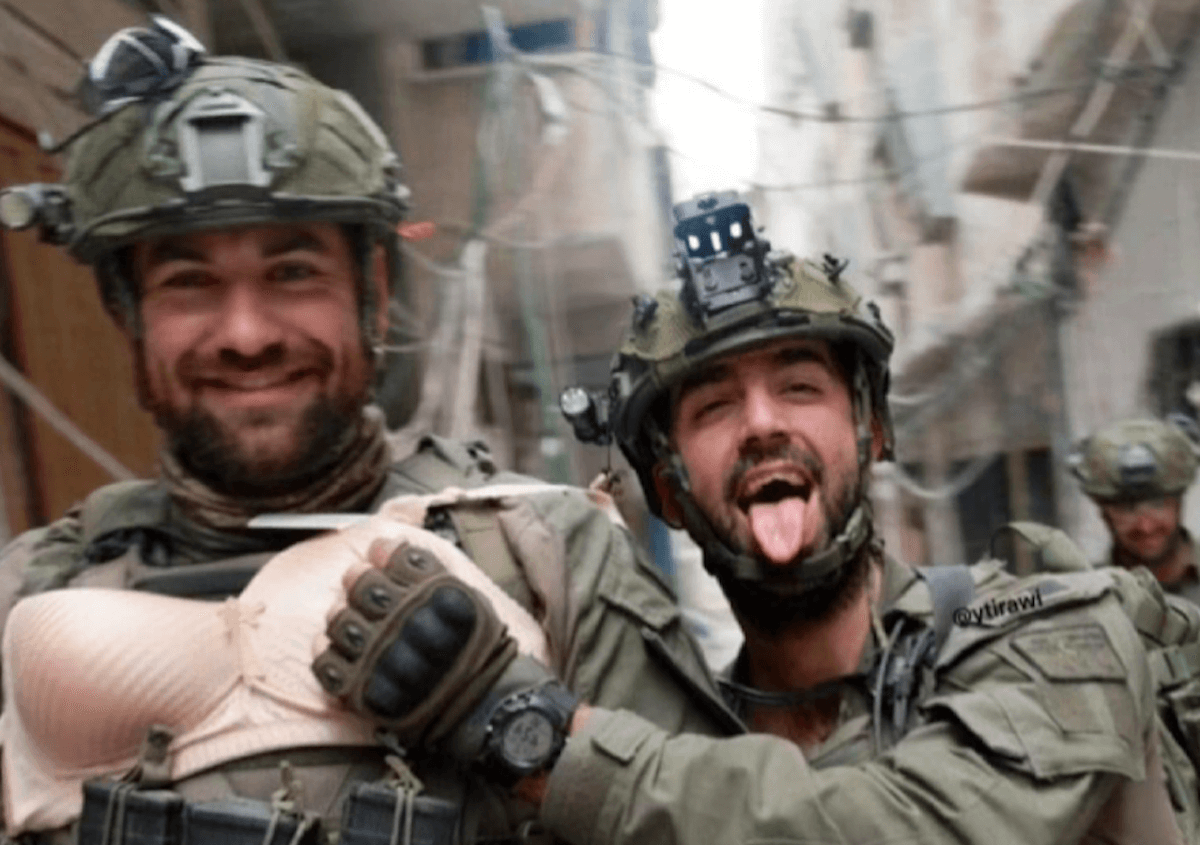
Two years ago, in July 2024, an Israeli news channel showed footage that would come to highlight one of the least discussed aspects of Israeli occupation and genocide. The video showed bound, naked Palestinians sprawled across the floor of the Sde Teiman torture camp1, located in the Naqab desert. One of the men is then separated from the group and taken to the wall. The soldiers - part of Force 100, tasked with guarding the camp - then use their shields to hide what they are about to do next.
They rape the captive.
The victim suffered, according to the Israeli physician who would go on to treat him, “a ruptured bowel, a severe injury to his anus, lung damage and broken ribs.” This instance, in and of itself, was horrifying, though not necessarily surprising to those who have long read and heard of Israel’s culture of systematic sexual violence against Palestinians — inside and outside prisons, during and outside the genocide of the past three years. The video, which was leaked to Channel 12, led to a display of Israeli politics and society that, until that point, hadn’t entered the global conversation: as the involved soldiers were detained for questioning and charged, Israeli lawmakers debated the utility of raping Palestinian captives; Israeli protesters stormed military facilities to ‘free’ the detained soldiers; journalists defended the rape but criticized the planning; and Israeli media hosted one of the accused, who defended the actions of his team to a cheering Israeli audience.
The nine accused soldiers were all eventually acquitted of any wrong-doing and the Israeli military’s top legal officer was arrested after she admitted to being the one to leak the footage.
What was striking was not only the sexual violence itself or even the degree to which it was defended and celebrated, but how little any of it seemed to disturb the dominant Western understanding of Israeli society. There was no attempt to read the episode as evidence of some deeper cultural pathology; no rush to explain Israeli sexual violence through religion, tradition, repression or an allegedly diseased national psyche. There were no long-form essays or reports or headlines bringing in experts on Judaism and situating the event within religious doctrine or the documented history of systematic sexual violence that began with the Zionist Jewish colonization itself.
The violence - when mentioned - remained, for the most part, a distasteful aberration, something committed by individuals or institutions rather than proof of what an entire people fundamentally are.
For more than a century, Arabs and Muslims have been subjected to a very different interpretive regime, one in which sex, gender and violence are transformed into evidence of civilizational defect and inferiority. Sexual opulence becomes evidence of being ungovernable. Sexual repression becomes fanaticism; misogyny becomes cultural essence; violence against women becomes proof of a uniquely diseased masculinity and sexual violence becomes not simply something that happens, but something that reveals who they are.
The question, then, is not why sexual violence exists in one society and not another; it is why some societies are allowed to produce violence without becoming defined by it and why others are made pathological - deviant - through theirs.
There is, in fact, an answer.
The Arbiters of Sexual Repression, Deviance and Control
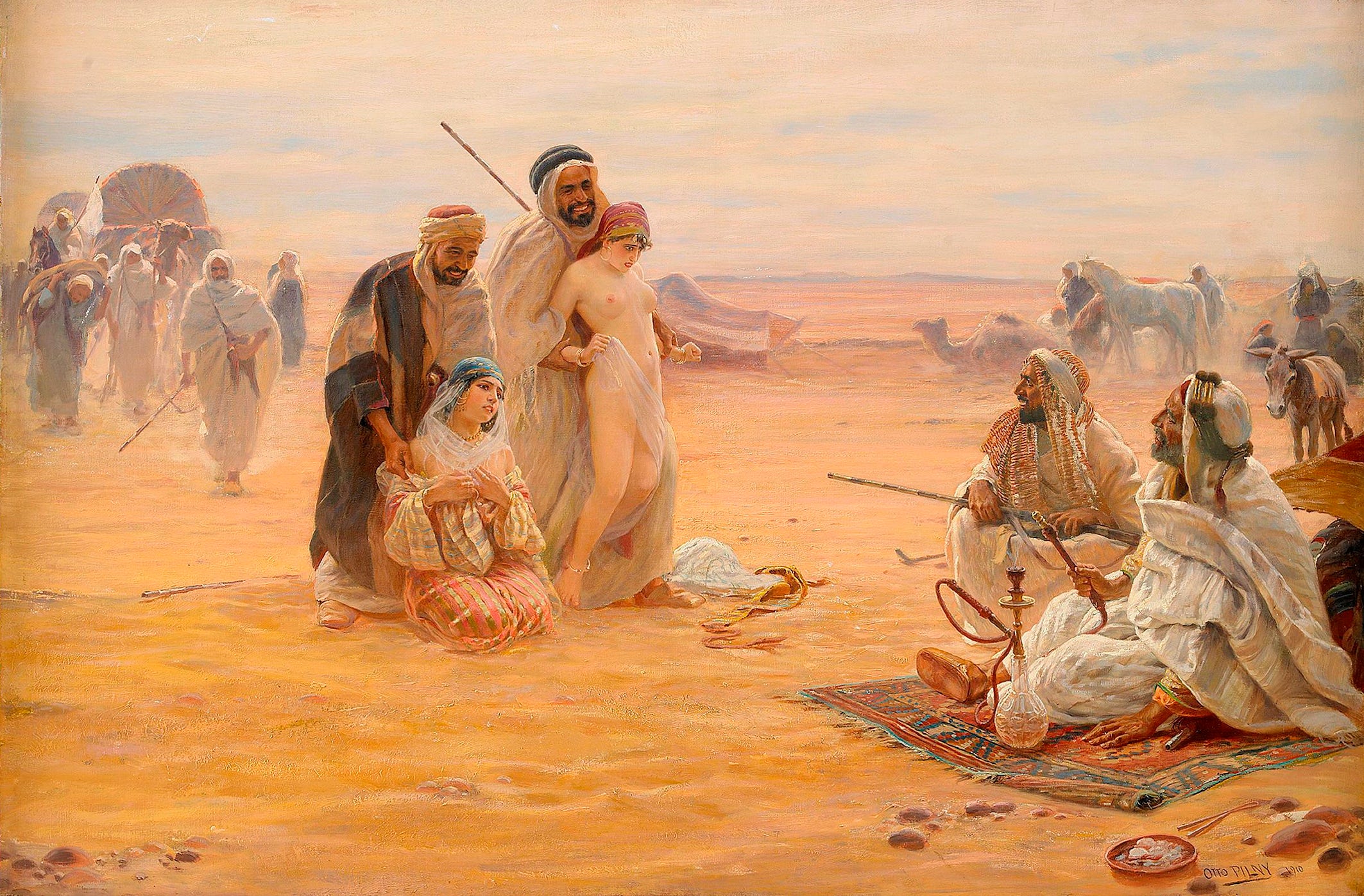
One of the very first papers I ever wrote, as a Middle East Studies major in 2007, was looking at orientalist motifs of Muslim, Arab and Amazigh women in 19th century French and British art. Up until this point, I hadn’t intellectually grappled with these depictions, done exclusively by European artists, many of whom had never actually been to the lands they chose to depict let alone seen the women they chose to depict in the manner they desired. These works of art were, in every sense, fantastical explorations intended to imagine the excesses, secrets and terrains of a region Europeans, for the first time, were entering - not as explorers, but as invaders. The Middle East (a term itself created by Europeans to situate the region within their spheres of conquering and control) was a blank canvas upon which Christo-European fantasies of sex, the body, climate and religion - in direct opposition to realities at home - could be extracted. Orientalist painters were the arbiters of these fantasies of sexual excesses, sexual repressions.
And the fantasies were endless: these paintings, which depicted people in these societies in varying scenes of life, provided a stark contrast to what Europeans presumably saw in their own homes, on their streets, in their families and their intimate relationships.
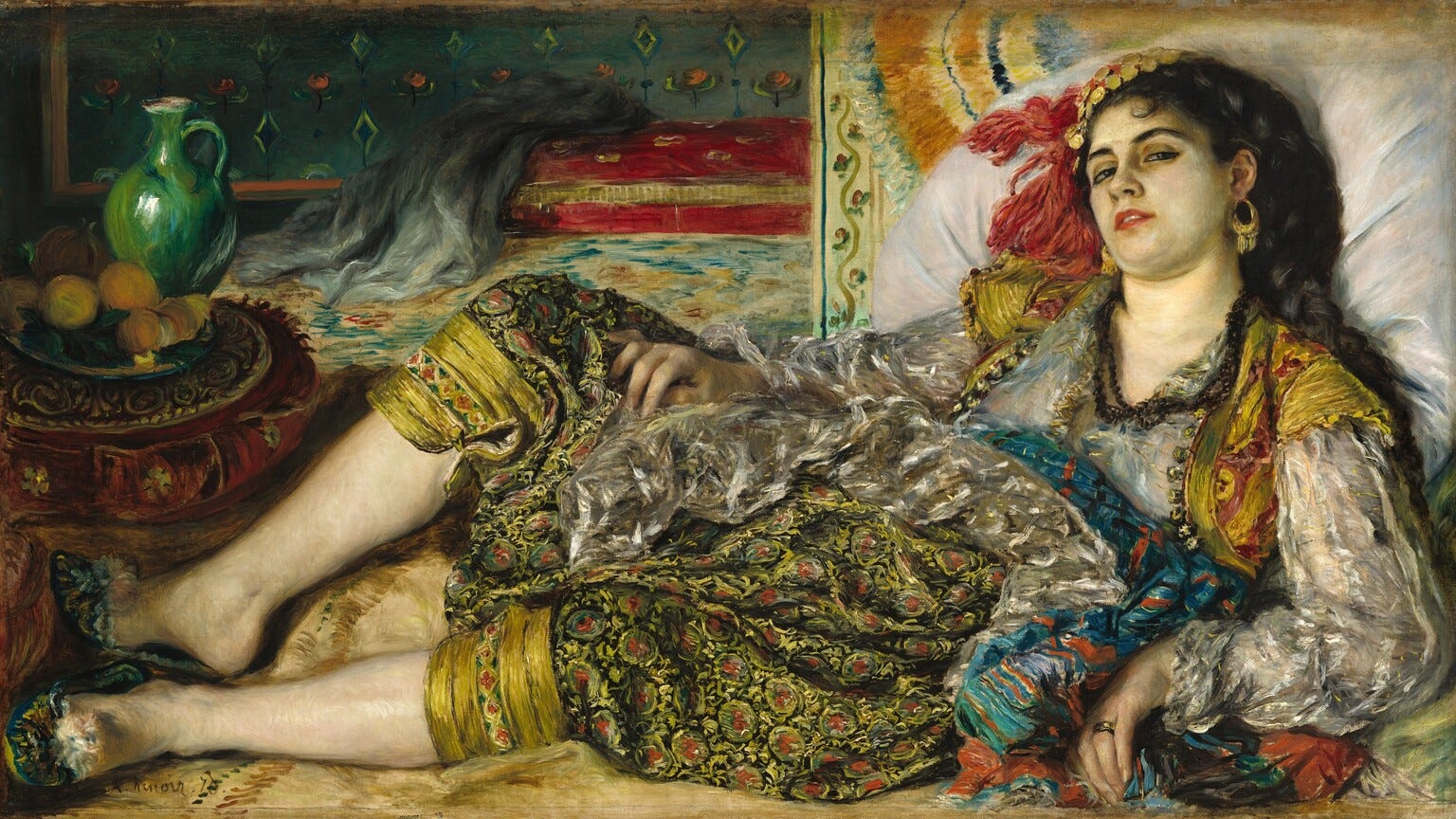
Edward Said, in Orientalism and Culture and Imperialism, famously pioneered the idea of the ‘Orient’ - the ‘East’ - as an ideological creation of Christo-European knowledge and imagination in order to justify imperialist violence and expansionism. For Said, Orientalism - a term used to define the work and influence of self-ascribed Orientalist scholars and artists focusing on the ‘Orient’ - was the epistemic, moral and political work necessary to create conditions that would inform, narratively, the projects of salvation these Christian European nations saw themselves as entrusted with (the theft of resources was, of course, just an added benefit).
I don’t mean for this to become an Edward Said 101 essay - but it is difficult to talk about pathologies of sex and deviancy, especially around Muslim and Arab populations, and ignore Said’s contributions to the study and development of discourse and the role of its tropes and motifs in justifying colonial and imperial violence, subjugation and expansionism. I would also be remiss to not mention Joseph Massad’s seminal Desiring Arabs here which looks at the internalization of European depictions in Arab engagements with their own sex and desire in the 20th century as well as the evolution of European depictions of Arab/Muslim sexuality from uncontrolled to repressed.
Now, up until my very youthful examination of orientalist motifs depicting the imagined women of the Orient, I had a limited epistemic understanding of the reality I had already been living as a young Muslim woman who was wearing the hijab in the social violence of the War on Terror. I was wrapped up in the pro-war narratives of Muslim women’s salvation - the primary, perhaps exclusive, binary I understood was how we, as Muslim women, were depicted as oppressed and how our male co-religionists were depicted as our oppressors. Examining orientalist artwork allowed me, as a teenager, to put a historical discourse on not just these binary depictions but also develop a deeper understanding of the role sex and sexuality played in how me and my male co-religionists, in particular, were seen in relation to one another in our most intimate of moments.
What became clear was that the gendered War on Terror discourse, that spoke of Muslim women in one way and men in another, was rooted in the characterization of Muslims having.a pathological relationship with sex.
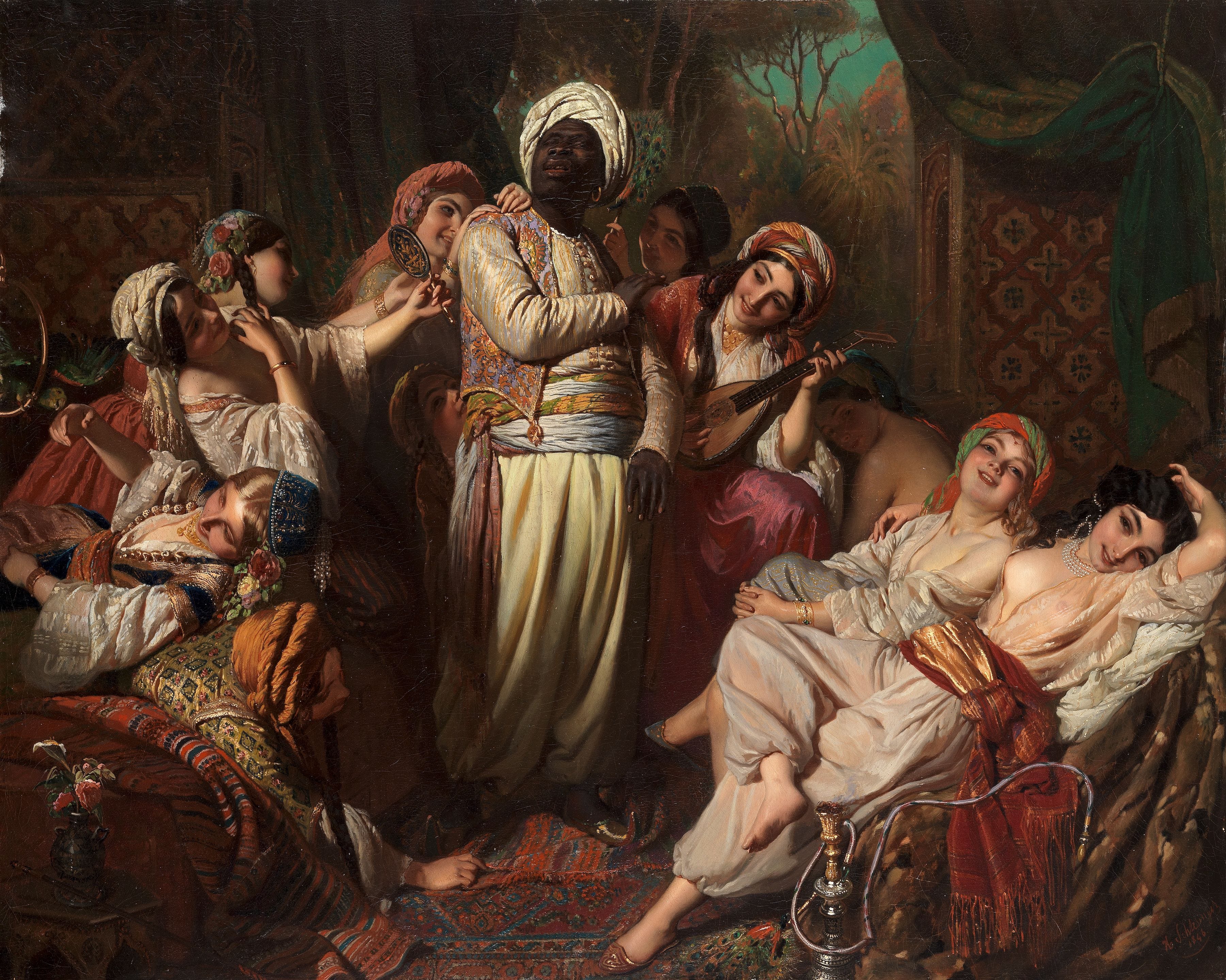
And what became even more apparent over time is that the ‘West’ did not merely claim authority to judge Muslim political systems or religious doctrines - it also appointed itself an arbiter of Muslim intimacy. The ‘West’, for centuries now, has claimed to know what happened ‘beneath the veil’, behind the bedroom door, inside the ‘harem’, within marriages, between men, between women, between husbands and wives. And from those imagined intimate spaces it derived sweeping conclusions about (manufactured) civilizational value - imagined intimate spaces depicted anywhere from nineteenth-century oil paintings to twenty-first-century political campaigns over veiling. The form may have changed but the presumption remained the same: that Muslim intimacy was available for Euro-American2 judgment and diagnosis - and, ultimately, action.
This characterization of entire peoples as possessing a pathological relationship to sex is not unique to Muslims or Arabs. It runs throughout colonial and racial discourse: enslaved Africans were cast as hypersexual and morally unrestrained; Indigenous peoples in the Americas as sexually primitive or deviant; Hindus in the subcontinent as trapped in degraded marital and sexual customs; Chinese migrants as promiscuous, diseased or associated with prostitution. Again and again, sexual ‘difference’ was transformed into evidence of civilizational inferiority - and then used to justify domination, conversion, segregation and imperialist rule.
It’s worth noting that these depictions weren’t widespread and readily available to every single subject of Euro-American societies - the average French peasant, in the 19th century, wasn’t standing in a gallery ruminating on Eugene Delacroix’ illustrations of the ‘inside of a harem in Oran’. Instead, these depictions were consumed by the audiences they were meant for: artists, scholars, colonial administrators, publishers, collectors and the bourgeois publics they addressed and were patronized by - this is the same audience that had the power and ability to reproduce what it was that it was consuming and reproduce images and ideas in spaces of political and ideological influence.
The Age of Mass Media and the Sexually Deviant Muslim Man
These tropes did not disappear as colonial rule changed form; they became more sophisticated, embedded in the institutions producing knowledge and culture. And as the mass production of culture and ideas evolves, we see these ideas spread, from exhibitions to newspapers to advertising to pop culture and, of course, political culture. What we witness, especially throughout the 20th century as colonized societies are beginning to gain semblances of freedom, is that elite fantasies are being hardened into social common sense through increased visual and written media.
The ideas about the people of the so-called East or Orient are no longer confined to polite, intellectual and cultured society. They now, increasingly with every passing year, are becoming inseparable from the lay citizen’s knowledge and understanding of the “foreigner”. And these ideas aren’t simply reproductions of caricature - they’re also, as they always have, playing the functions of violence, citizenry-making, resource/labor theft and border creation. If dark-skinned Africans could be constructed as inherently primitive - morally undisciplined, sexually excessive, intellectually inferior and incapable of self-rule - then their subjugation could be represented not as theft and violence, but as the natural ordering of unequal peoples.3
And so, as mass media expands across Euro-American societies, these ideas move beyond elite circles of knowledge and cultural production and become part of a broader imperial common sense: a way of understanding not only the peoples being ruled, but the relationship between ruler and ruled itself. And, perhaps more importantly, these ideas - the tropes and motifs included - are simultaneously being used and reproduced among the elites of the colonized societies too in order to deputize them on behalf of empire.4
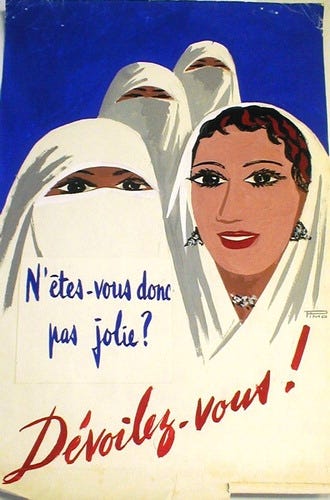
Thus there’s no surprise that these ubiquitous tropes and motifs about Arabs and Muslims5 make their way into the industry of journalism, itself shaped by the same institutions of knowledge and cultural production. For all its claims to objectivity, Western journalism functions as an extension of imperial knowledge-making, reproducing inherited ideas about populations historically treated as objects of Western power. This is how it works: institutions may modernize but ideas accumulate on top of one another, changing maybe in form but not very often in function.
And so by the time we see a headline about the dirty, old men of Pakistan or sex and Islam or veiling in Iran or education rights of young girls in Afghanistan or ISIS enforcing sexual slavery or by the time we see a scene in a film where white woman is gawked upon by bearded locals, we are not only epistemically primed to accepting these framings as primary experiences of What Those Men Do and What Those Women Experience6 but we also expect these framings.
It’s easy to look at the aforementioned as disparate narratives - rooted in some truths - but taken together and placed within centuries of discourse about Muslims, Arabs and sex, these narratives acquire a meaning larger than their individual facts and realities: they suggest a people with a pathological relationship to sex, an inherent deviance located somewhere within their culture, religion or men. There’s little room left to ask about the material conditions that produce particular forms of oppression, the layers of class, state and geopolitical power and interference within them, or why comparable violence elsewhere so rarely becomes evidence of a nation or civilization’s pathology - and evidence of necessitating a ‘solution’.
That absence is, of course, by design. To invoke history and material conditions is to implicate Euro-American power, past and present; explicitly or otherwise, it raises the possibility that something may be foundationally wrong not with them, but with us, the perpetrators of specific kinds of violence and conditions - the kind that Aimé Césaire said “works to decivilize the colonizer, to brutalize him…to awaken him to buried instincts, to covetousness, violence, race hatred, and moral relativism.”
And we can’t have that, can we?
Sexual Violence, the Jewish state and Dismantling Pathologies of the Native
Since October 2023, stories of Israeli sexual violence have been a mainstay of the flood of information
Dr. Adnan al-Bursh, head of orthopedics at Gaza’s Al-Shifa Hospital, was raped to death in an Israeli torture camp. Israeli soldiers playing with and wearing intimate clothing belonging to Palestinian women in homes they had emptied out became a mainstay of the images soldiers would boastfully post to social media. Palestinian men and boys, held in Israeli torture camps, have been subjected to rape “with hard objects like metal rods, wooden sticks, and fire extinguisher nozzles”.
Palestinian women, especially since October 2023, “have been searched, forced to strip, repeatedly beaten on their genitals, photographed naked, and then threatened with or sometimes subjected to rape.”
The Israelis used dogs to rape Palestinian captives.
In 2025, the UN Commission of Inquiry found that Israel has systematically used sexual, reproductive and gender-based violence against Palestinians - including rape, forced nudity, sexual assault, attacks on reproductive healthcare and measures preventing births- as tools of domination, persecution and, in Gaza, acts it concluded were genocidal.
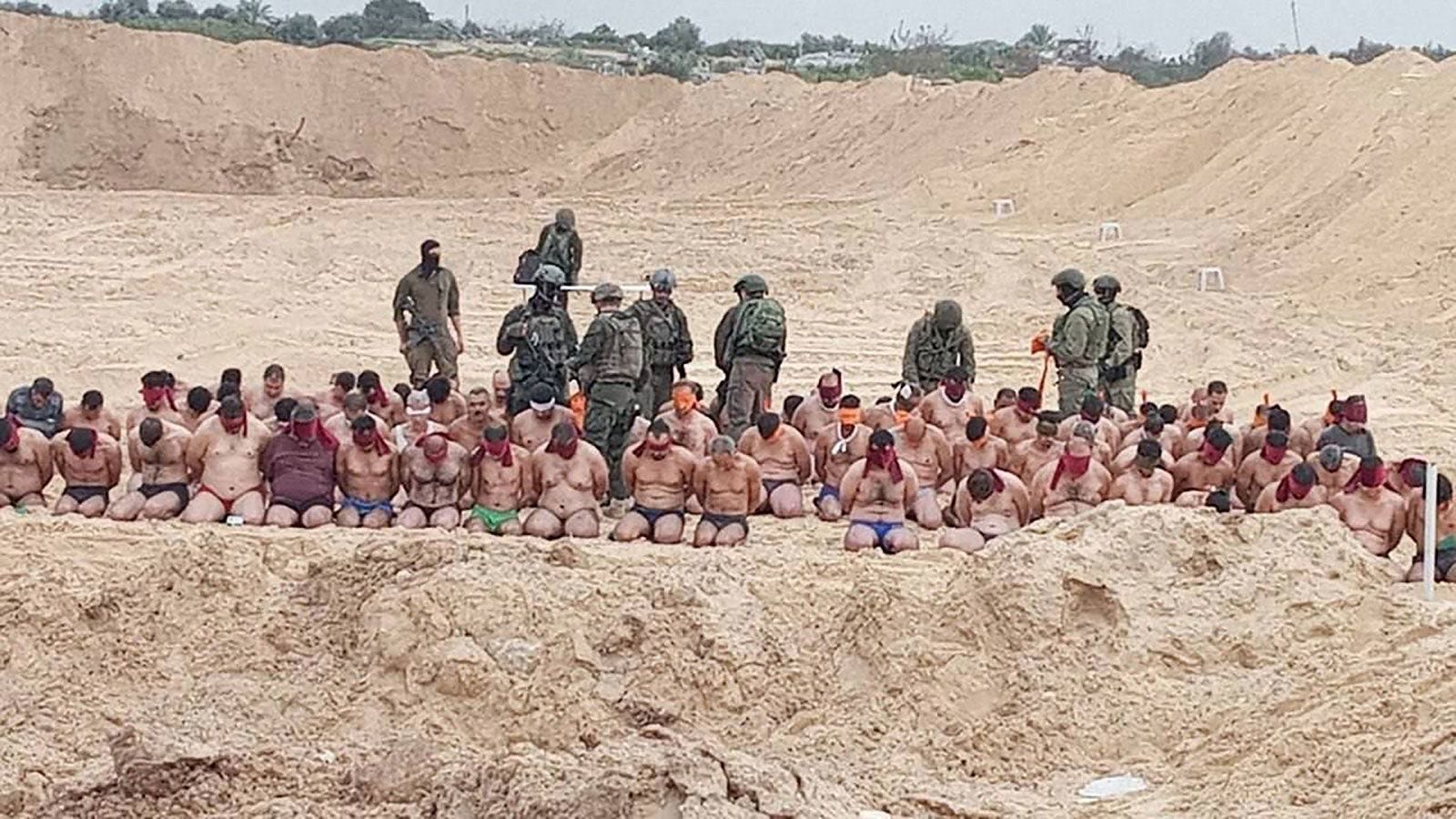
This is, of course, not anywhere near a full audit of the horrors of systematic and societal sexual violence that has come to define a large - and under-discussed - part of Israel’s decades long projects of extermination, occupation and apartheid. But in mainstream news and political discourse, this violence does not come to define Israel. It certainly does not come to define Israeli society or politics, Israelis or Jews, their culture or religious doctrine. It is presented, at worst, as an aberration, rendered politically inconsequential because of who its victims are.
Unproven but repeated allegations of October 7th rapes of Israeli women by Palestinian resistance fighters became foundational to the rationale that the Israeli campaign of extermination of the Palestinians - backed militarily, institutionally and culturally by every Western state - had to continue.
We are confronted with the political reality that sexual assault against Israeli women is being weaponized in the service of manufacturing consent for genocide against Palestinian men, women, and children in Gaza. Or, as many have stated, the allegation of mass rape is being deliberately deployed to justify the mass slaughter of Palestinian people in Gaza, to justify domicide — the mass destruction of civic infrastructure and homes in Gaza, and to justify the forcible transfer of Palestinian people from Gaza. - Randa Abdel-Fattah, January 2024
And in this is the answer to the question I posed at the very beginning: why are some societies allowed to produce violence without becoming defined by it and why are others made pathological - deviant - through theirs?
Because how does a single instance of alleged sexual violence come to hold the power it does - invoked to justify the annihilation of entire bloodlines - while decades of documented state sexual violence produce no comparable political or media discourse about what is fundamentally wrong with Israeli society? Where are the long-form lamentations about Israeli sexual repression, Israeli masculinity, Jewish religious doctrine or some uniquely Jewish relationship to sex and violence?
My argument is not that there is simply a double standard or that Western society is partial to Israel and racist toward Arabs and Muslims. These are symptoms of something much larger: a political order in which some people are permitted to commit violence as people, while the violence of others is made into evidence of what kind of people they are. The violence of the colonized is made evidence of something diseased within and inseparable from him: religion, culture, masculinity, sexuality. Colonial violence, even when institutionalized and reproduced across generations, is treated as something else entirely - at worst an aberration and at best, when employed against ‘the enemy’, tragic but ultimately necessary. Colonial violence is almost anything except evidence of the system that produces it. In other words, my argument here is how violence acquires meaning and what that meaning then justifies.
Calling colonialism- and thus contemporary American imperialism - pathological is not making the same move I am critiquing in reverse. A colonial pathology is not an ‘essence’ attributed to a people; it’s a condition produced by a relationship of power.
Césaire understood colonialism as a process that brutalizes not only the colonized but the society that carries it out; Franz Fanon described a colonial world organized through the absolute division of colonizer and native, a structure sustained by violence and the continual degradation of the people it dominates. Colonial rule requires this degradation, it must continually produce the native as threatening enough to fear, backward enough to govern, violent enough to contain and, eventually, disposable enough to kill. Massad, in Islam in Liberalism, extends this argument to how liberalism constitutes itself in part through imagining/essentializing Islam in an oppositional way.
Living inside the Archive
What we are seeing in Israel is not evidence of some primordial Jewish pathology nor of something inherent to Judaism or Jews. It is evidence of what happens when dominating, dispossessing and dehumanizing a people becomes necessary to maintaining the order of colonial / imperial violence. That is the pathology of colonization - and the reason there are not big discourses in our political and media institutions about Israeli sexual violence and culture is because that violence is a reproduction of the very same violence (especially sexual violence) that underlies the histories of the development of what collectively is called the West. Israel cannot be simply understood as a production of Jewish history of persecution in Europe, but rather the production of Euro-American colonial expansionism, occupation and slaughter.
The function of these contemporary depictions, rooted in older colonial ones, remains much the same. As Edward Said argued (though, as Wael Hallaq has suggested, perhaps not far enough) colonial and imperial knowledge is never simply descriptive. The ideas and images produced about people under colonial power establish the terms through which their actions, and the violence committed against them, are understood.
And so the native is made backward, irrational, sexually deviant, violent and incapable of self-rule; when he commits any act of violence, it is only ever understood as an explanation of who he is, who his people are. His violence is an indictment of his nation and nothing else. Colonial violence, meanwhile, can be made to mean something entirely different, especially that it is necessary. This is what it means to give violence meaning: the act does not speak for itself. Instead, an existing political and ideological order tells us what the act reveals, whose violence requires explanation and whose violence becomes the explanation.
We can relegate certain ideas, images and imaginations to the past - but there is an archive. And so what happens to that archive? It is inherited and it lives and develops into a mode of thinking about ourselves - as purveyors of colonial violence or as subjects of it - that continues to be deeply tied to our institutions of governance, law and life. Domination, after all, has always required a story about who is civilized and who is deviant - and about what thus the mission is.
So, who are the sexual perverts?
‘Torture camp’ is the most accurate description of what maybe referred to the Israeli prison system otherwise. Palestinian men, women and children are routinely held without charge, often for decades, and forced to endure physical, sexual and psychological abuse.
I prefer using this to ‘the West’ as it explicitly maps out regions in discussing a category of epistemic power but it still is, of course, limited as ‘America’ is vast and not simply the USA. But I use ‘America’ to specify the US in particular given the hegemonic understanding of ‘American power’. I do use these terms (the West and Euro-American) interchangeably from time to time as I am figuring out what language I find sufficient to capture complex histories and ideas that have coalesced around similar ideologies on race, citizenry, God and the State. Don’t @ me.
If the idea of being a ‘human’ was being defined as rational and Christian - inextricably tied to skin color and geographic origin - then it was easy to exclude many populations from that category. And once people are cast out of full humanity, they are converted into property and labor to be extracted and exploited. This idea of extraction - that renders the colonized as vassals of labor and resources - is what underpins the unique character of European colonialism.
There is so much more to be said about how discourses about colonized nations have been adopted by these nations through ‘local’ knowledge production and the impact of that on class formation and the furthering of imperialist violence via militarism, ngos, global economic institutions and international organizations. Arguably, the most successful cultural project of colonization was epistemic colonization, which ensures that full sovereignty is never actualized.
This piece focuses on Arabs and Muslims - categories vaguely defined to include populations thrown under these umbrellas by virtue of proximity and majoritarian governance/culture.
Men are made agents of pathology whereas women become its permanent objects.
Great article Sana. And thank you for going beyond the point most would stop at- it’s absolutely not an inversion nor a double standard. It is by absolute design. This was so clarifying and enlightening.
Think about the amount that, for instance, the Dreyfus affair, has entered the popular understanding of the wrong done by our own societies towards certain minorities. Then compare how Dreyfus was treated compared to this Palestinian captive. Then consider the amount of soul-searching we do for the one case and the other. This will be instructive